
In contrast to later styles of dress I present on this page, we do not have complete garments preserved from the Viking age. Most pieces of fabric are leftover from graves or the port of Haithabu, where they were used as racks (Hägg, 1984). For example, one of the largest pieces found there has the measurement of a modern piece of paper. Therefore, it is hard to determine the exact shape and patterns of the fashion they were part of. As a consequence, my dresses have to be seen as one option of interpretation. They are based upon the excavation reports of Haithabu and various other primary and secondary sources, for example the graves at Birka, that Inga Hägg sum up in 2015 in a German book, which is my main reference (see further reading below).
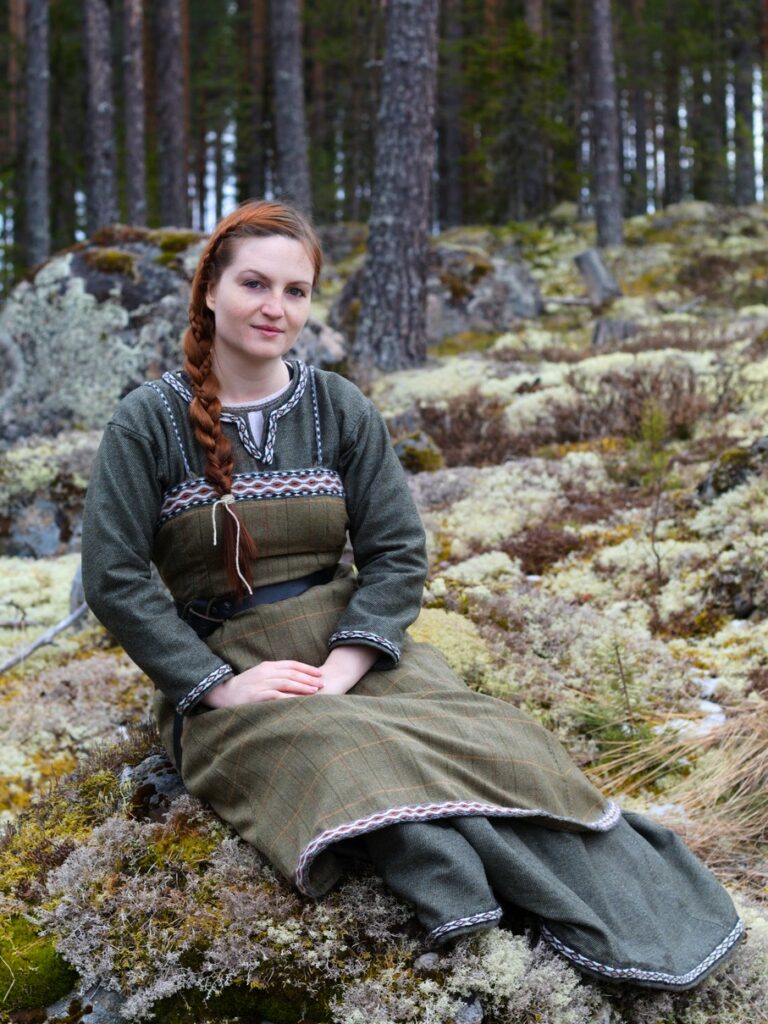
Since they were often used by several people before wearing out (Hägg, 2015, S. 170f.), and were considered very expensive, I try not to waste any leftover pieces of fabric and alter my dresses a lot. By the way, the garments were dyed with natural fibers and ingredients. This was expensive and mainly used by upper class people (2015, S. 171f.). However, I only tried this out once. The majority of my fabric is simply dyed with chemical substances during production. Historically, fabric was weaved by hand on a vertical loom. Of course, I cannot keep up to this standard. Various techniques were used, so that the fabric had a lot of different textures (Hägg, 2015, S. 123, 126 u. 131). Wool and linen were the most common fibers, the latter one beeing imported and therefore expensive (Hägg, 2015, S. 119 u. 122). Fragments of silk were found as well (Hägg, 2015, S. 115 u. 175). Further, we do not know if hide was used commonly, so I try to avoid it. However, rich fur was used for decorative elements, or even immitatet by those who could not afford it (Hägg, 2015, S. 171). Hägg suggests that the burial clothing must have been exceptional rich garmants, so that it is not a direct window to daily wear (Hägg, 2015, S. 138 u. 168). Economic status was not shown on the base of a special pattern or type of garment, but by the fibers and quality of fabric (Hägg, 2015. S. 170f.).
When cutting the fabric, near to zero is wasted due to the simple pattern pieces I design. All garments had to be sewn by hand. I mainly use linen thread. To be honest, I do not know if the thread was dyed, too, but often use the matching color anyway.
Clothing for Women
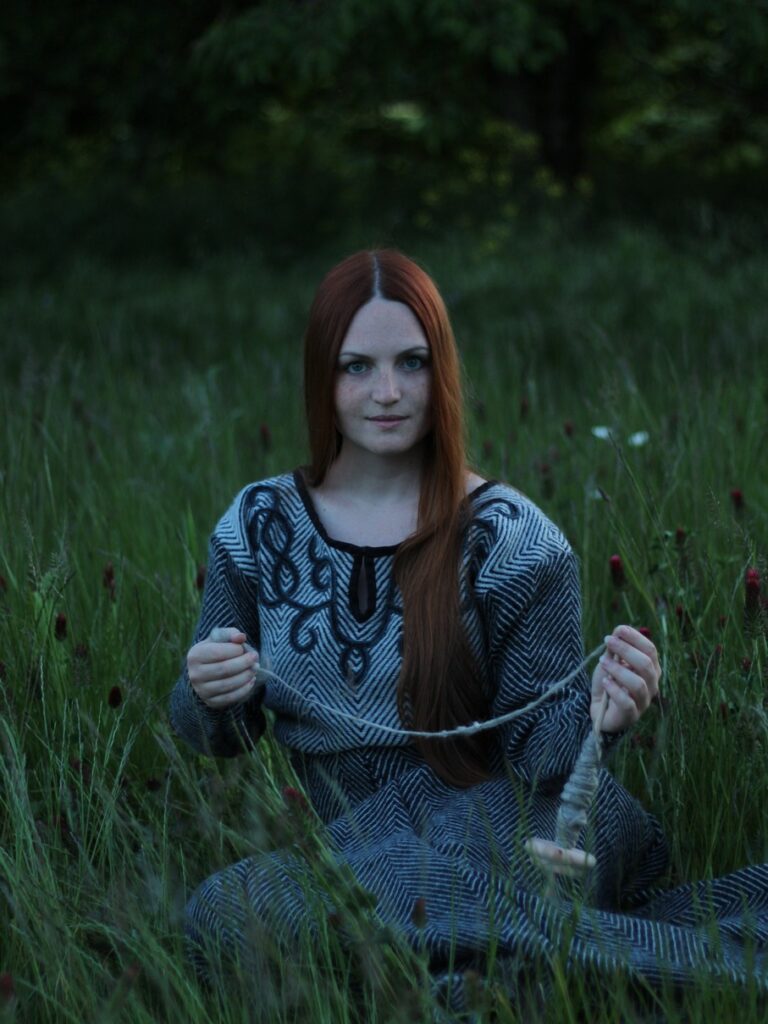
A simple shift served as a base layer to various styles of Viking age women’s clothing (Hägg, 2015, S. 51f.). Front and back are simple rectangles. To gain more width, several gores are added at the sides and on the centre front and back. The sleeves can be made from rectangles, too (although there are several pattern suggestions). For more freedom of movement, I add small pieces of fabric to the underarm. The garment could be made from wool as well, like the one shown in the photo. It is even more common in the grave, since linen was considered expensive and may be imported (Hägg, 2015, S. 119 u. 122). However, I clearly recommend to wear a linen one underneath to prevent your skin from irritating. The diagonal structure in the weaving pattern is known from excavations at Birka (Hägg, 2015, S. 173).
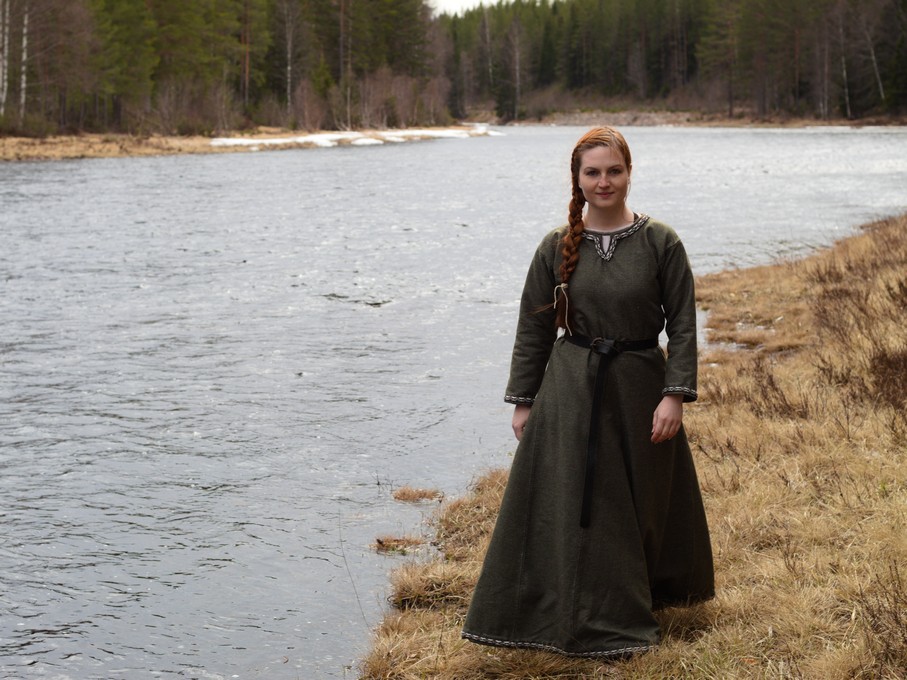
Inga Hägg discussed another type of dress with a seam that divides the dress into an upper and a lower part (2015, S. 51f.). My interpretation of this style can be seen here.
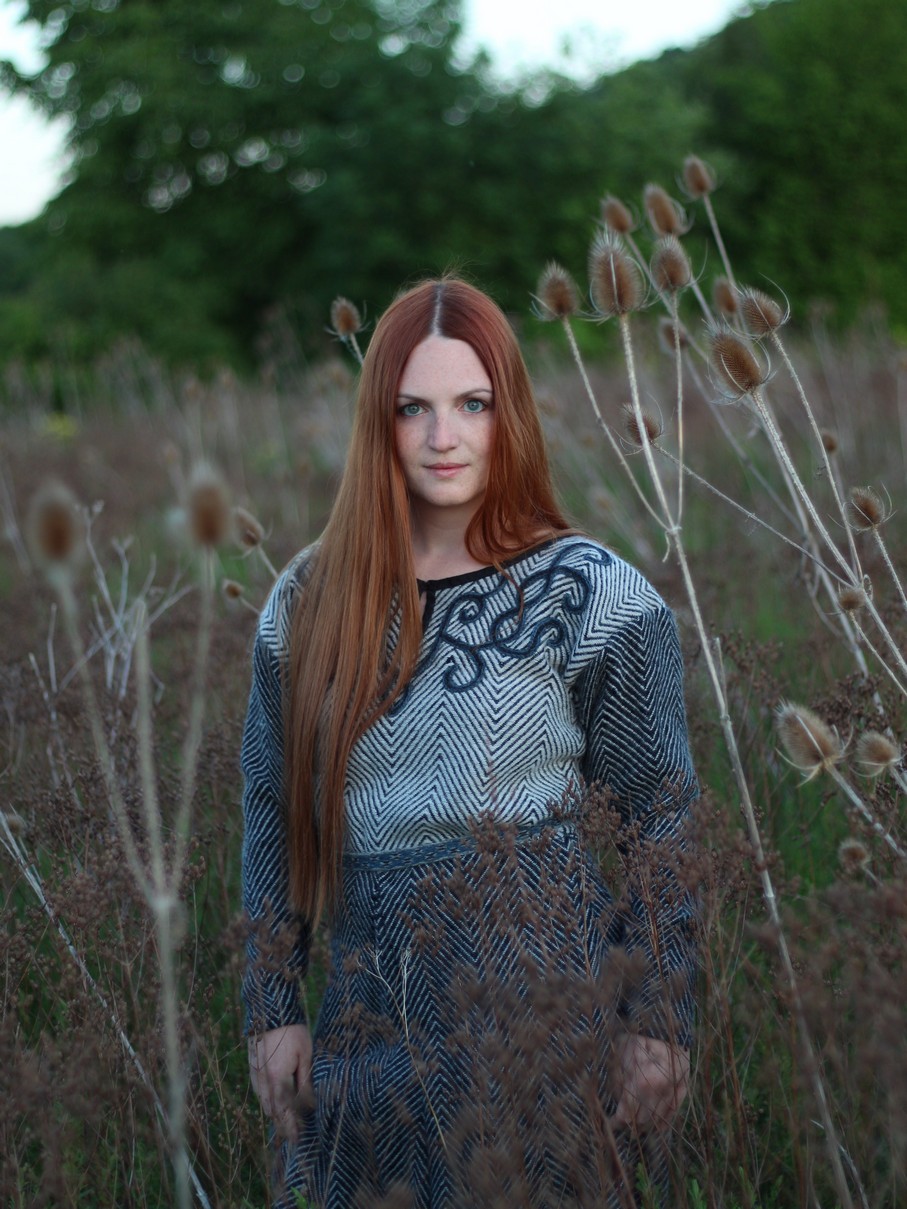
Further, there are examples at Birka that suggest pleated shifts existed as well (Hägg, 2015, S. 124). However, I did not sew this style yet.
The so-called apron dress basically looks like a tube widened by gores and is an upper garment (Hägg, 2015, S. 50f.). Surprisingly, the garment is considered to be very close to the body due to darts on the front and back panels. Therefore, I add a lacing to my apron dresses. Several other styles, eg. with an open front, a not considered to exist, due to Inga Hägg, who discussed this in detail (2015, S. 60-67). Of course, wool can be used as well, to create an outfit suitable for colder wheather. You can also spot trimming made with the card weaving method. I added instructions for making this garment as well (upcoming). A Tartan-like pattern has been found at Birka (Hägg, 2015, S. 171). I wear my apron dresses with a belt, since Inga Hägg spotted signs of a belt on an original dress (may have been worn over an outer layer, 2015, S. 50f.).
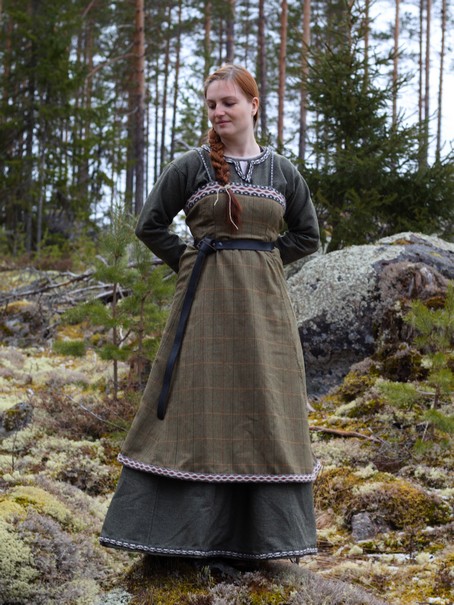
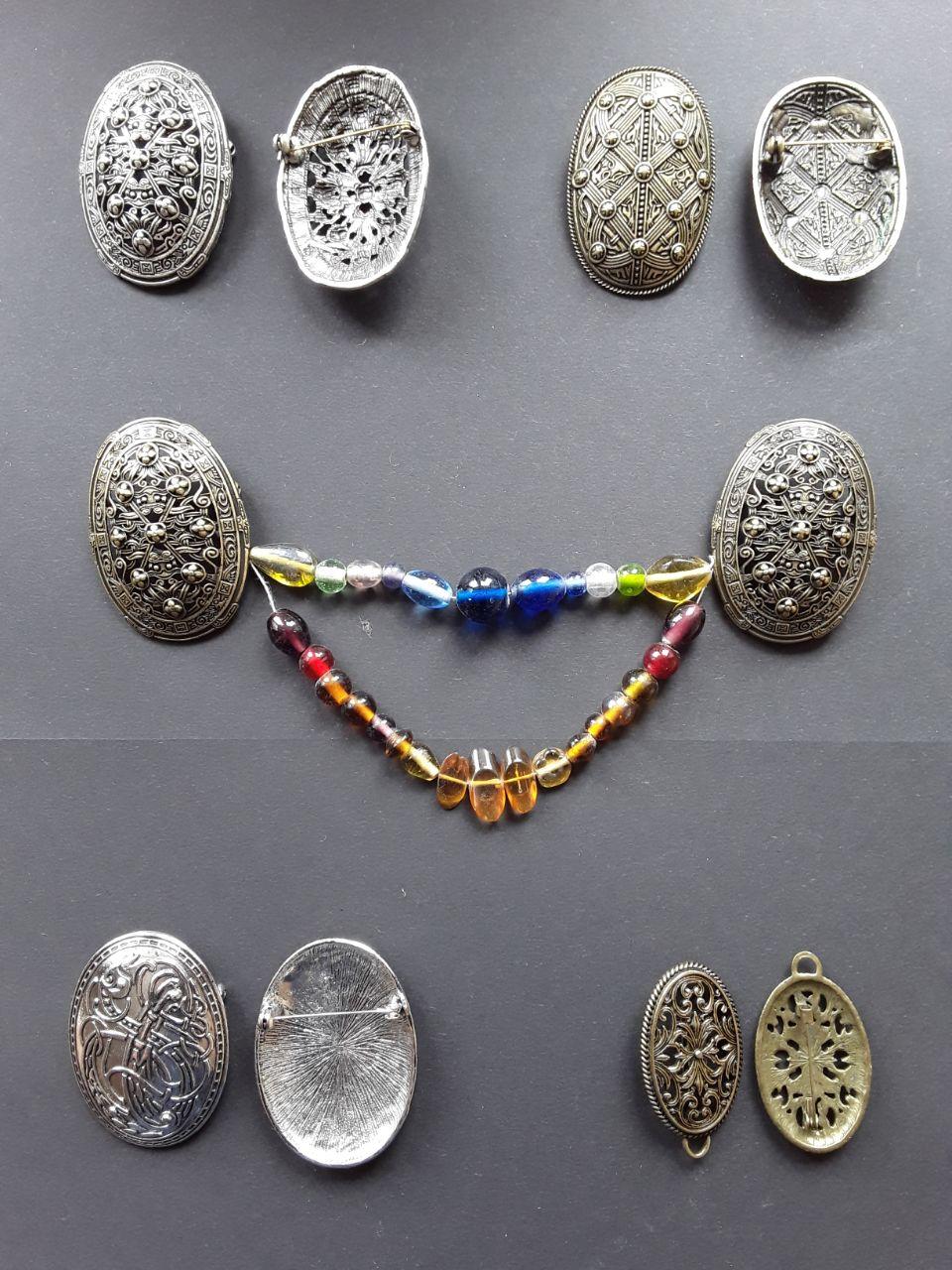
The apron dress is kept on its place with the help of straps (Hägg, 2015, S. 61). In a lot of graves, oval brooches were found there. They could be very rich and rather big. Mine are very small. At the end of the 9th century, they appear less in the graves, which does not mean the brooches or even the apron dresses went out of style at this period (Hägg, 2015, S. 164f.). A lot of reenactors wear glass beads on a string between the brooches. The next photo features my collection of brooches. Beware that the two pairs on thed bottom are my first pieces. I could not find any records of similar original ones. According to some early 20th century drawings (featured at VikingAgeCompedium), the upper right is called the P25 from Norway and dated from the 800s.
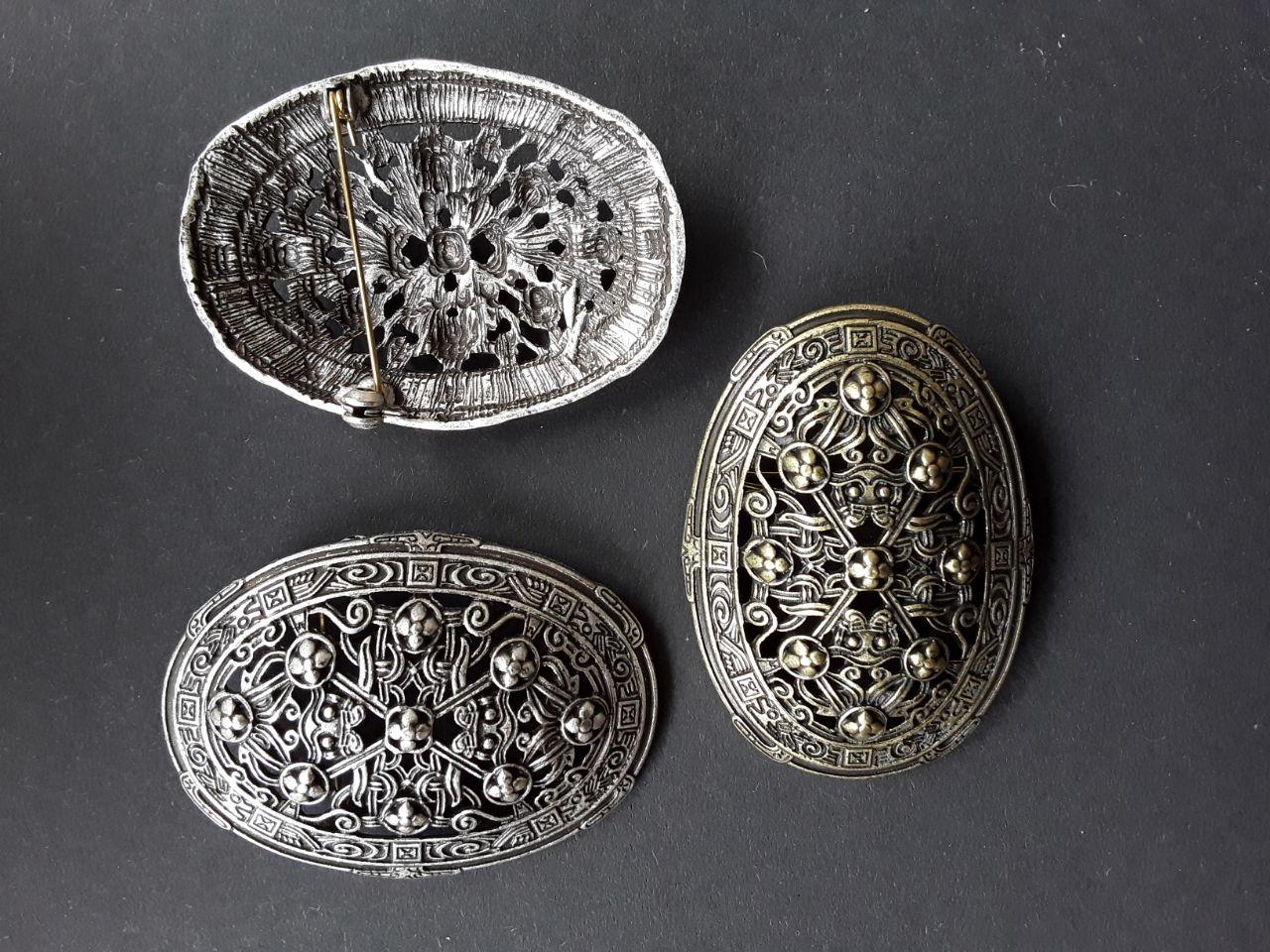
The following are my favourite pair, that means to represent a late Oseberg style like the P51 (featured at VikingAgeCompedium) from the early 900s:
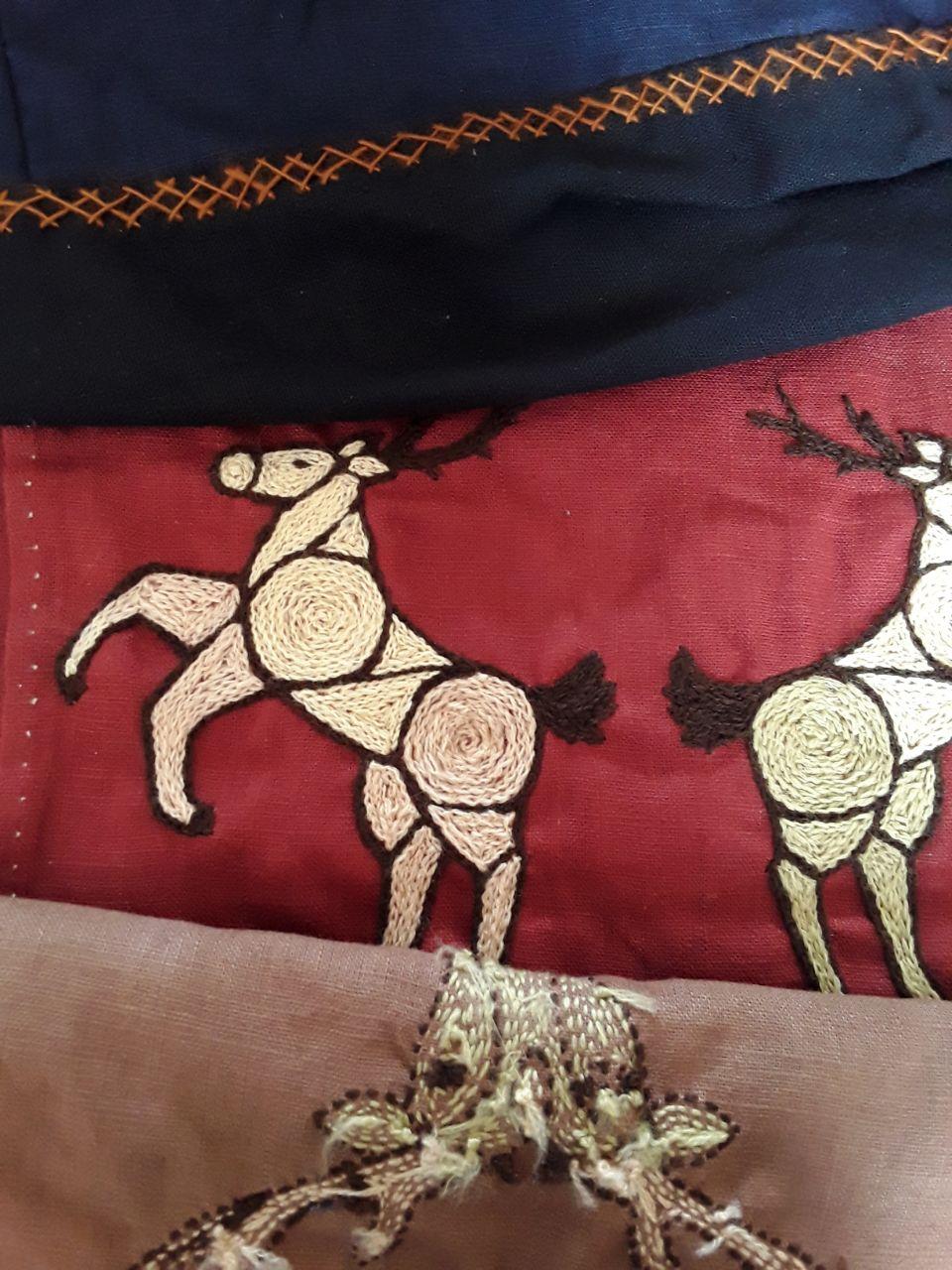
Another status symbol could have been an embroidered apron hanging down from the brooches. At least it is in reenactment, when everybody suits up for feasts. The pattern is rather simple and can be found here (upcoming). By the way, my combination of woolen embroidery on linen fabric is not the exact one found at graves. There is no exact evidence.
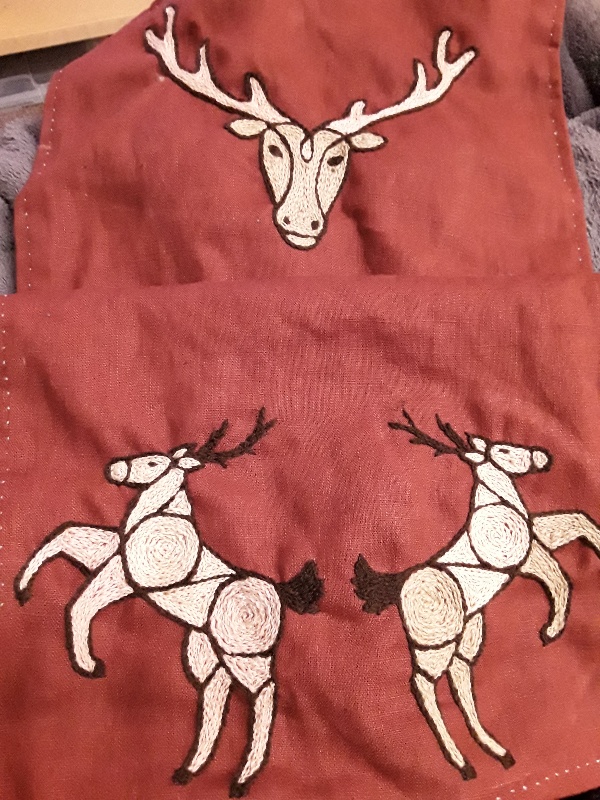
The embroidery found on the famous Oseberg ship is worked in silk and includes “satin stitch, split stitch, stem stitch, and couching” (TRC II, 2016) In general, the techniques named for the Viking period are “chain stitch, raised herringbone stitch, stem stitch, and couching” (TRC I, 2016). However, I could not find any suggestions which stitch was used for creating a specific pattern, so I had to use my imagination when creating these:
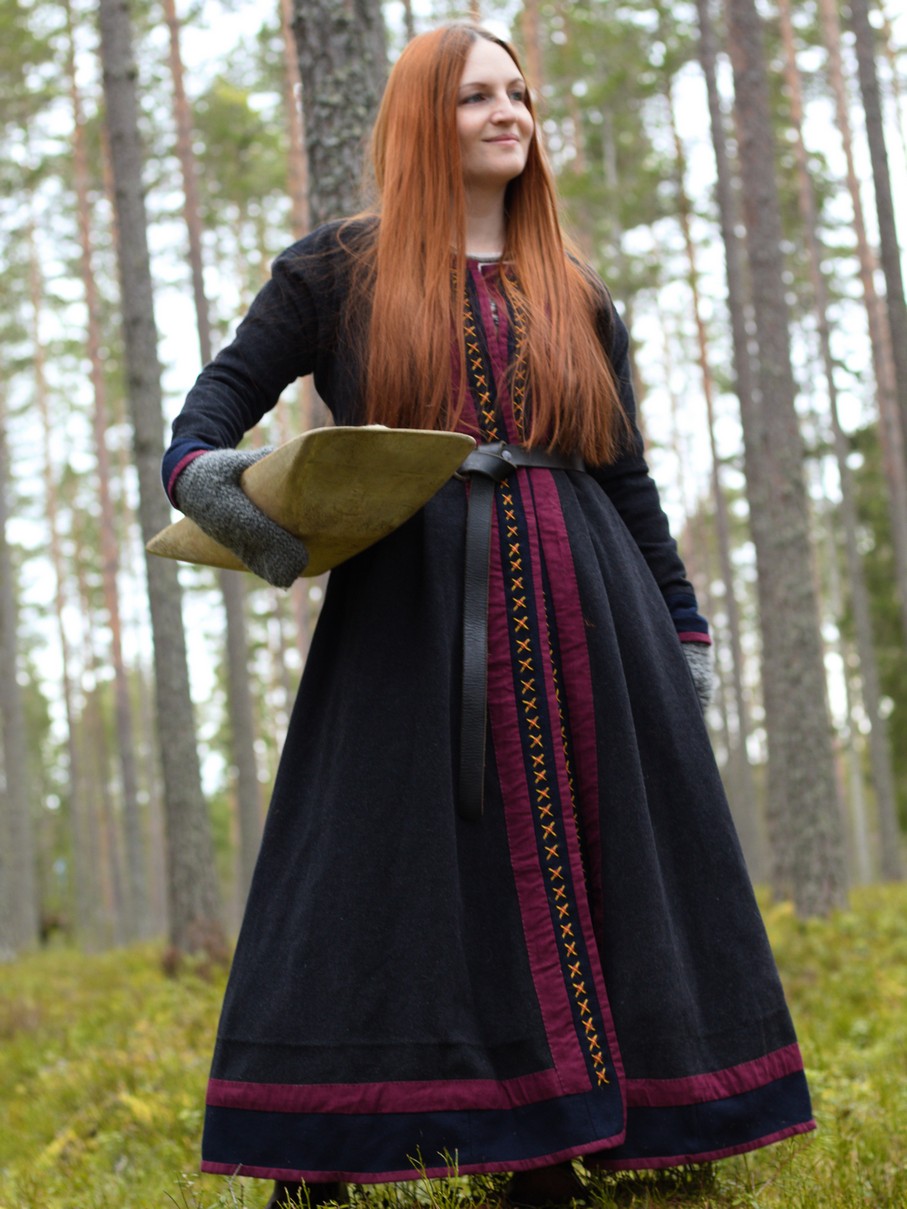
As an outer layer, I sewed a mantle. However, this style has to be seen critically. The original reference to a style like this found at Birka was dismissed by Inga Hägg (2015, S. 52f.). Instead, she writes about an over tunic and does not mention an opening in the front.
Literature (German):
– Hägg, Inga: Die Textilfunde aus dem Hafen von Haithabu, (Berichte über die Ausgrabungen in Haithabu, hrsg. v. Archäologisches Landesmuseum der Christian-Albrechts-Universität), 1984.
– Hägg, Inga: Die Textilfunde aus der Siedlung und aus den Gräbern von Haithabu. Beschreibung und Gliederung, (Berichte über die Ausgrabungen in Haithabu, hrsg. v. Archäologisches Landesmuseum der Christian-Albrechts-Universität), 1991.
– Hägg, Inga: Textilien und Tracht in Haithabu und Schleswig, 2015.
– Groenman-van Waateringe, Willy: Die Lederfunde von Haithabu, (Berichte über die Ausgrabungen in Haithabu, hrsg. v. Archäologisches Landesmuseum der Christian-Albrechts-Universität), 1984.
– Textile Research Centre Leiden (I): Viking Embroidery, online at: https://trc-leiden.nl/trc-needles/regional-traditions/europe-and-north-america/embroideries/viking-embroidery [Last update 2016, last viewed on 27th June 2020, 12:15 Uhr].
– Textile Research Centre Leiden (II): Oseberg Ship Burial (Norway), online at: https://trc-leiden.nl/trc-needles/individual-textiles-and-textile-types/fragments-and-panels/oseberg-ship-burial-norway [Last update 2016, last viewed on 27th June 2020, 12:15 Uhr].
– For drawings of oval brooches: The Viking Age Compendium: Brooches – Viking Paired Styles, online at http://www.vikingage.org/wiki/wiki/Brooches_-_Viking_Paired_Styles [Last viewed on 27th June 2020, 12:50 Uhr].